All I can say is... brace yourself, it's a long one!
We knew we had much to cover in the state of Pennsylvania, so we only planned for one night at our first campground near Pittsburgh. We fully intended to set up camp then head right out to experience downtown and the Three Rivers area...but we were exhausted. After resting, we had just enough time to meet Jim's insurance agent downtown for dinner. We chose Primanti Brother's, a Pittsburgh tradition since the 30's and home of the "almost famous" sandwich menu. All of their sandwiches are served with the sides (fries & coleslaw) inside.
We knew we had much to cover in the state of Pennsylvania, so we only planned for one night at our first campground near Pittsburgh. We fully intended to set up camp then head right out to experience downtown and the Three Rivers area...but we were exhausted. After resting, we had just enough time to meet Jim's insurance agent downtown for dinner. We chose Primanti Brother's, a Pittsburgh tradition since the 30's and home of the "almost famous" sandwich menu. All of their sandwiches are served with the sides (fries & coleslaw) inside.

We were bummed though, that this was all we got to see of the town. Known as "The City of Bridges", the area forms a triangular shape, carved by the joining of the Allegheny & Monongahela Rivers, which form the Ohio River. A beautiful city surrounded by water and bridges galore...446 to be exact! But we were around too much history to waste our time in a big city, so on to our first fort!
Fort Necessity, in the summer of 1754, was home to the opening action of the French & Indian War. Known elsewhere as the Seven Years' War, it was a battle between England and France for the control of North America and ended in 1763 with the removal of French power from North America and India. The battle at Fort Necessity, though, was not a victory for the English. On the morning of July 3 a force of nearly 600 French and 100 Indians approached the fort and Washington's command of only 293 men. By the end of the day negotiations were in place for a surrender. It was the first major event in the military career of 22 year old George Washington and was the only time he ever surrendered to an enemy.
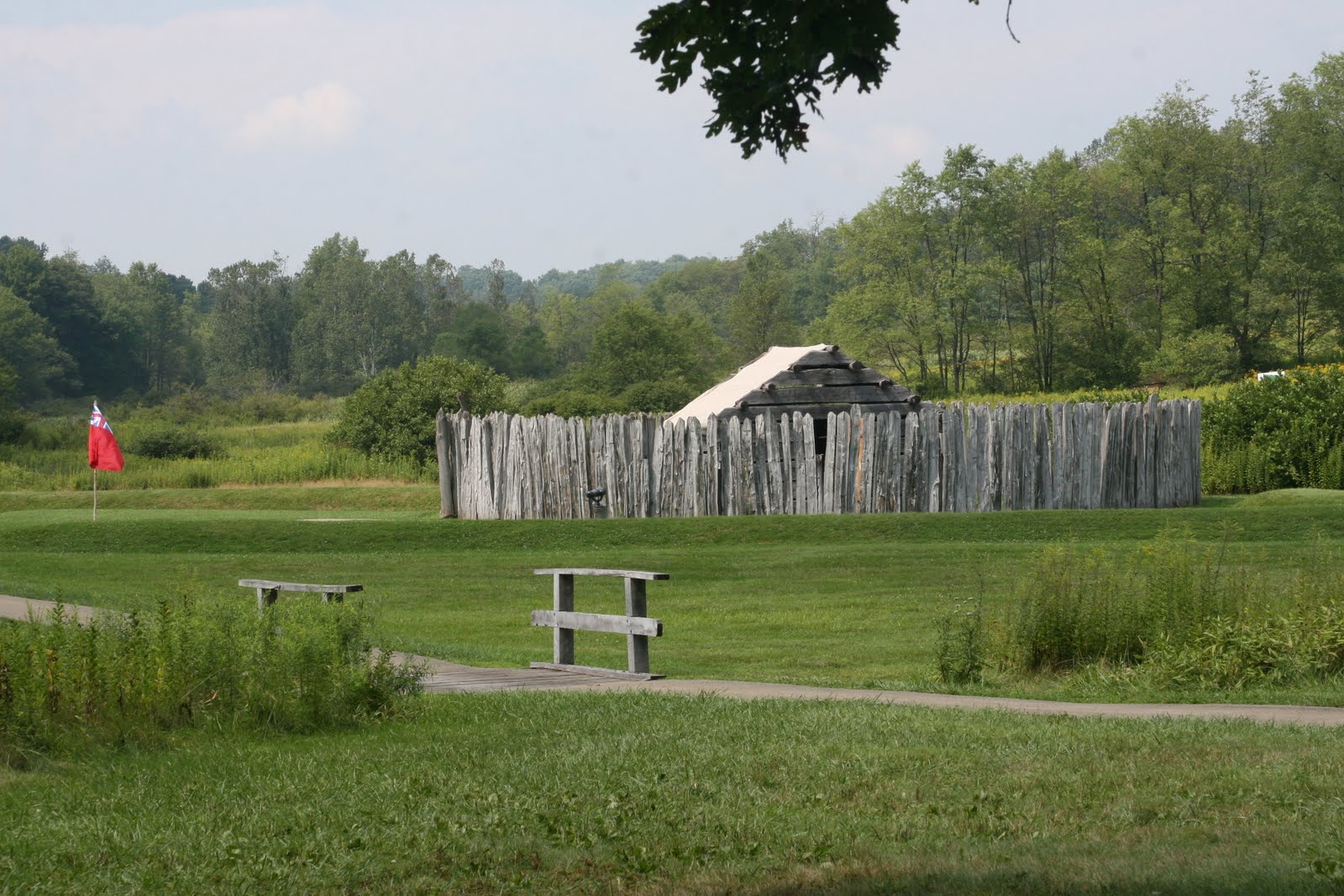 |
| Fort Necessity |
 |
| Description of the structure inside the fort |
 |
| Watching a demonstration by costumed park rangers |
The following year Major General Braddock, commander-in-chief over all the British forces in North America, personally led an expedition against the French at Fort Duquesne (in present day Pittsburgh) with his 2,400 men. Braddock and his men followed the road Washington had taken on his way to Fort Necessity the previous year. After crossing the Monongohela River, British forces collided head-on with exploding musket fire and the whooping of Indians and their French allies. Disorganization and fear seized the British and within three hours the Battle was over with 900 casualties out of the 1,400 men engaged. Braddock was carried from the field severely wounded and died the following week as the surviving British camped at the sight of Fort Necessity. Washington officiated a ceremony as Braddock was buried in the road his men had taken. The army then marched over the grave to eliminate any traces of it.
 |
| "This tablet marks the spot where General Edward Braddock was buried July 14, 1755. His remains were removed in 1804 to the site of the present monument." |


Next, we drove east to Gettysburg, which ended up being another Marmon favorite. We've learned that when visiting any National (especially historical) park, to first stop in the visitor's center. There we found information on the day's activities, the free ranger-guided tours, Jr. ranger programs, maps to self-guided auto (& audio) tours, and loads of information. Gettysburg's "National Military Park Museum & Visitor's Center" held a large museum, a theater showing a short film on the area's history and a beautiful cyclorama... an original 1883 oil-on-canvas painting that covered the walls of a large, circular room. It's life-like pictures told the moving story of the 3rd and final day of the battle.
 |
| The Marmons with Abe |
The battle of Gettysburg was a turning point in the Civil War, the Union victory that ended General Robert E. Lee's second and most ambitious invasion of the North in 1863. Often referred to as the "High Water Mark of the Rebellion", it was the war's bloodiest battle with 51,000 casualties and the setting for Abraham Lincoln's "Gettysburg Address".
It was actually chilling to walk the sites where so many men lost their lives. Original cannons were scattered throughout the battlefields as well as wooden fencing & stone walls just as the farmers would have had them.


And the monuments... more than could be counted. Some marked the location of headquarters or where individual units fought while others honored individual men.
 |
| The largest monument on the battlefield belonged to the state of Pennsylvania, who provided more than 23,000 men to the battle at Gettysburg. |

 |
| We walked through the battlefields with Park Rangers giving informative tours. |
 |
| This is the high ground held by the Union army known as Little Round Top. The view is taken from Devil's Den where many Confederate soldiers lost their lives. |
 |
| On the 2nd day of the battle, eleven different brigades attacked and counter attacked here at the Wheatfield for over 2 hours, resulting in 6,000 casualties here alone. |
We also toured the Soldiers' National Cemetery which contains the graves of more than 6,000 U.S. servicemen, including 3,580 Union soldiers killed in the Civil War.

 |
| The cemetery held several plots of unknown graves, as nearly half of the Civil War burials are unknown soldiers. |
 |
| This monument commemorates Lincoln's Gettysburg address. On the morning of November 19, 1863, nearly 20,000 statesmen, soldiers and citizens converged here to consecrate the new Soldiers' National Cemetery. Lincoln spoke deliberately and without gestures as the crowd listened in silence. His infamous speech lasted only 2 minutes. |


The Eternal Light Peace Memorial was dedicated by President Franklin Roosevelt on the 75th anniversary of the battle. Over 1,800 Civil War veterans attended the ceremony, their average age being 94.
"All of them we honor, not asking under which Flag they fought then- thankful that they stand together under one Flag now." -President Franklin Roosevelt
Even walking the streets of "downtown" Gettysburg was rich with history.

Homes and barns had been used as shelters for sharpshooters and field hospitals for the injured and dying.
 |
| During the battle this house (now restaurant) sheltered Confederate sharpshooters... more than 100 bullet holes can still be seen in this wall (the white marks). |
 |
| These plaques, seen all around town point out the Civil War buildings still standing today. |
With a little research, we found out about the U.S. Christian Commission...a group of heroes that served upon the battlefields of the Civil War bringing goods, supplies & the Gospel to the soldiers. The Wega family has made it their mission to share this history and the spiritual element of our founding nation. We attended a Civil War chapel tour as well as a Christian Commission tent-style church service.

By the time our visit to Gettysburg was through, the girls earned their Ranger badges and our brains were mush:)

With so much history saturating our brains over the past week, we were all in need of a mindless day so we took time to play at our campground, then spent a full day in Hershey!


First was the Chocolate World Tour... an amusement park-type ride that gave us a "tour" through the Hershey factory. Then Hershey park. Unfortunately, it was a busy time to visit with ride wait-times averaging 45 minutes. It was a fun park, but what could possibly compare after conquering the rides at Cedar Point?!?
From Hershey we visited the home to the oldest and largest Amish community in the United States, Lancaster, PA. Members of this conservative Christian faith came to Pennsylvania in the 1720's to escape persecution in Europe for their Anabaptist beliefs. They are a conservative group, emphasizing humility, family, community and separation from the non-Amish world (anyone not Amish is considered "english"), which includes a reluctance to adopt modern conveniences such as electricity... or rubber tires...


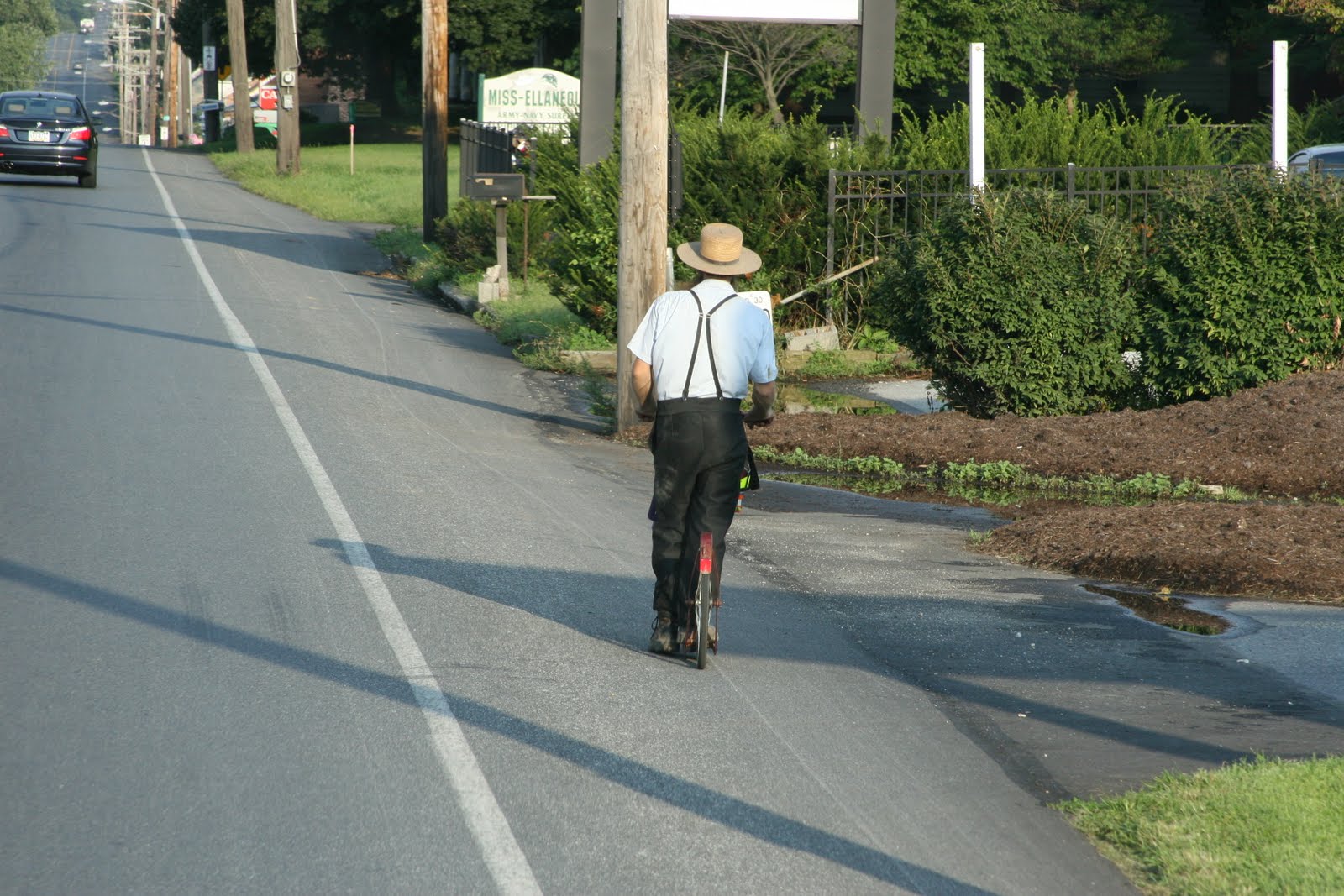
We were surprised with how touristy the area was, but once away from the shops, restaurants & tour facilities, the drive through the farm land was breathtaking. We could tell the Amish homes by the dark green curtains in the windows, impeccable gardens and clotheslines with their "plain" clothes.

 |
| Tobacco crops are common and several barns could be seen with the tobacco leaves hanging inside to dry. |
We toured the Pennsylvania Amish Country, stopping at Amish-made shops & bakeries, trying shoo-fly pie, whoopie pies, home made soft pretzels and fresh home made root beer.

 |
| Amish-made items in the gift shops. |
A highlight in this area was actually at a Mennonite center. They had recreated, as described in Scripture, Moses' Tabernacle in the wilderness and gave us a guided lecture tour explaining it's significance as we gazed at the structure. It gave a beautiful visual to the descriptions read in Scripture.
Photos weren't allowed:(
 |
| A painting by art students from the Mennonite school representing the camp of the Israelites. |
As we made our way toward Philadelphia, we spent a day at Valley Forge, the site of the 1777-1778 winter encampment of the Continental Army under General George Washington. As two key battles had recently been lost to the British and winter approaching, Washington chose the site of Valley Forge for their fixed camp by mid December. Though provisions weren't abundant, the army located supplies, built log cabins, constructed make-shift clothing and gear and cooked meals.


 |
| Log cabins like these were built for their winter camp. |
It was disease, such as influenza, typhus, typhoid & dysentery, not cold or starvation, that was the true hardship of the camp.
Possibly the most important outcome of the encampment was the army's maturation into a more professional force. In February 1778, Baron Friedrich von Steuben arrived, giving the men training to be a more unified and powerful army.
 |
| Demonstration of a musket fire by a costumed park ranger. |
 |
| General Washington used this home as his headquarters during the encampment. |
 |
| Much of the headquarters has been kept original, including the handrails along the staircase. A bit surreal walking the steps George & Martha walked! |
Our final (whew!) destination in Pennsylvania was to Philadelphia. We actually visited here last year and loved it... the Liberty Bell, the National Constitution Center, the Franklin Post Office, the Declaration House, First Bank of the U.S.... and we were glad we did, because this visit coincided with the onslaught of Hurricane Irene! We spent the day walking around in the increasing rains and everything closed early with the upcoming storms. We managed to fit in several historic presentations,

a stop at the Franklin Fountain for a "Stock Market Crunch" sundae,
 |
| Rocky Road ice cream covered in thick peanut butter sauce & topped with salty pretzel bites. Rocky Road ice cream was concocted in 1929 following the great stock market crash to give consumers something to smile about during the impending Depression. |
and a wet visit to the famous Pat's Steaks for Jim's favorite Philly cheesesteak.

By the following day, Irene hammered the area and we hunkered down at our campsite west of Philly. Rain literally blew sideways as we watched the news reports of the destruction around us. Trees were falling, streets were flooding, bridges were being taken out, and thousands lost power (including us), so our anticipated visit to NYC was postponed and the trip to New York brought careful route planning!


