Our first stay in Clinton, Connecticut was in close proximity to New Haven where we toured Yale University. We took a student-led walking tour in & around the campus.

Probably the most beautiful building there was the library. The builder had hoped to build a grand chapel on the campus, but the school would not allow a religious building on site. Instead, he built this "cathedral to knowledge."


A graduate from Yale, Nathan Hale answered George Washington's request by volunteering to spy behind enemy lines during the Revolutionary War. He spoke these now famous words before his hanging in September 1776: "I only regret that I have but one life to give for my country."


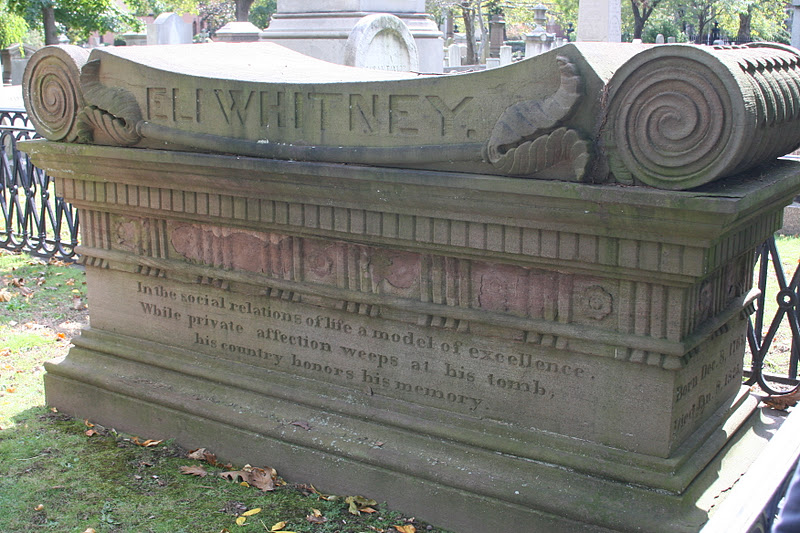
The nearby Grove Street Cemetery held the graves of Jedidiah Morse (known as the "Father of American Geography"), Eli Whitney (inventor of the cotton gin), and Noah Webster (best remembered for his Blue-Backed Speller & for writing the first American dictionary).



Our friends, the Lyons, insisted we couldn't leave the area without trying the famous Frank Pepe Pizzeria- and with a line out the door we knew it had to be good!

We also hit their recommendation next door- Libby's Italian Pastry Shop. It was though we were stepping in to an Italian Grandma's kitchen...


our cannolis & "lobster" were the bomb:)
Another day trip brought us to the home of Noah Webster in West Hartford & Connecticut's Old State House in Hartford.

We toured Noah Webster's home, but even more impactful was learning about the often understated influence he had on American culture. A graduate from Yale in 1778, his desire to attend law school was met with a lack of funds. He instead decided to teach and became increasingly frustrated with the American education system. Children of all ages were crammed into one-room schoolhouses with untrained teachers, few supplies, and "outdated" books that came from England...often pledging their allegiance to King George. In 1783 he wrote A Grammatical Institute of the English Language (the Blue-Backed Speller) which became the most popular American book of its time & taught children to read, spell and pronounce words for over 100 years.
In 1801 he started working on a book that would define the words Americans used. He strongly believed in the developing cultural independence of the United States and knew that a distinctive American language with its own dialect, pronunciation and style would contribute to this independence. His first edition, published in 1806 had 37,000 words and 22 years later he completed the American Dictionary of the English Language defining over 65,000 words. Over his lifetime, Webster also fought for copyright laws, the abolition of slavery, and universal education. He helped found Amherst College, created his own version of an American Bible, learned 26 languages, and corresponded with men like George Washington & Ben Franklin.
At our Kansas home we have copies of the original dictionary & school book and recommend looking through these fascinating books if you get the chance!
At our Kansas home we have copies of the original dictionary & school book and recommend looking through these fascinating books if you get the chance!

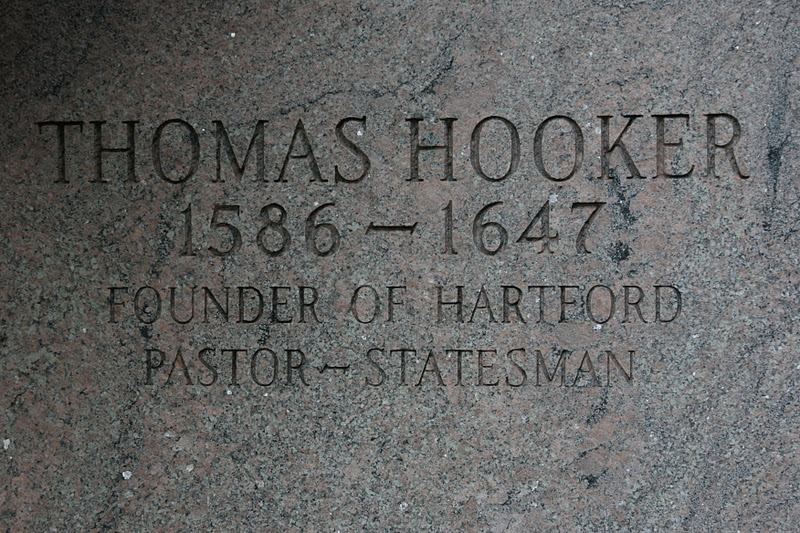
Near the Old State House in Hartford was this statue of Thomas Hooker, a well loved pastor who in 1636 established a community & church along the Connecticut River which he named Hartford. In 1638 his famous sermon on Deuteronomy 1:13 influenced the writing of the Fundamental Orders, a document which served as the constitution of Connecticut and is believed to be the world's first written democratic constitution that established a representative government.


We toured the fully restored Old State House which was site to Connecticut's earliest colonists. Feeling a bit of history overload (which we all occasionally experience!), the favorite in this building (though Natalie was a bit grossed-out) was the Museum of Curiosities & Oddities. Without National Geographic & Discovery Channel, museums like this were common & used for education. How else would a common person see a two-headed calf, a collection of amazon birds or a horn from a narwhal?!? Alayna especially loved this:)


Our campground in this area had a great tennis court which we used each morning before our daily excursions and the beautiful evenings allowed us to boil and clean our seashells from Maine. With just a few days here we were only able to cover a fraction of what we had hoped to see, but we were also anxious for our next state of New Jersey & the chance to slip into NYC... covered with flooding from Hurricane Irene during our previous visit.
A) New Haven, CT (Yale, Grove Street Cemetery, Pizza & Pastries)
B) Clinton, CT (Our Campground)
C) Hartford, CT (Old State House)
D) West Hartford, CT (Home of Noah Webster)
View Larger Map


